Grading Requirement for 3rd Kup
(Red Belt doing Black Tag Grading)
Hwa-Rang is named after the Hwa-Rang youth group that emerged during the Silla Dynasty around 600 AD. This group later played a key role in unifying the three Korean kingdoms. The 29 movements represent the 29th Infantry Division, where Taekwon-Do developed to its full maturity.
Hwa Rang Tul
Instructions:
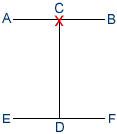
The instructions below assume that the student is standing on the X, facing D.
Start position: Closed Ready Stance C
- Move the left foot to B to form a sitting stance toward D while executing a middle pushing block to D with the left palm.
- Execute a middle punch to D with the right fist while maintaining a sitting stance toward D.
- Execute a middle punch to D with the left fist while maintaining a sitting stance toward D.
- Execute a twin forearm block while forming a left L-stance toward A, pivoting with the let foot.
- Execute an upward punch with the left fist while pulling the right side fist in front of the left shoulder, maintaining a left L-stance toward A.
- Execute a middle punch to A with the right fist while forming a right fixed stance toward A in a sliding motion.
- Execute a downward strike with the right knife-hand while forming a left vertical stance toward A, pulling the right foot.
- Move the left foot to A forming a left walking stance toward A while executing a middle punch to A with the left fist.
- Move the left foot to D forming a left walking stance toward D while executing a low block to D with the left forearm.
- Move the right foot to D forming a right walking stance toward D while executing a middle punch to D with the right fist.
- Pull the left foot toward the right foot while bringing the left palm to the right forefist, at the same time bending the right elbow about 45 degrees outward.
- Execute a middle side piercing kick to D with the right foot while pulling both hands in the opposite direction and then lower it to D forming a left L-stance toward D, at the same time executing a middle outward strike to D with the right knife-hand.
- Move the left foot to D forming a left walking stance toward D while executing a middle punch to D with the left fist.
- Move the right foot to D forming a right walking stance toward D at the same time executing a middle punch to D with the right fist.
- Move the left foot to E turning counter clockwise to form a right L-stance toward E while executing a middle guarding block to E with a knife-hand.
- Move the right foot to E forming a right walking stance toward E while executing a middle thrust to E with the right straight finger tip.
- Move the right foot on line EF forming a right L-stance toward F while executing a middle guarding block to F with a knife-hand.
- Execute a high turning kick to DF with the right foot and then lower it to F.
- Execute a high turning kick to CF with the left foot and then lower it to F forming a right L-stance toward F while executing a middle guarding block to F with a knife-hand. Perform 18 and 19 in a fast motion.
- Move the left foot to C forming a left walking stance toward C while executing a low block to C with the left forearm.
- Execute a middle punch to C with the right fist while forming a right L-stance toward C, pulling the left foot.
- Move the right foot to C forming a left L-stance toward C while executing a middle punch to C with the left fist.
- Move the left foot to C forming a right L-stance toward C while executing a middle punch to C with the right fist.
- Execute a pressing block with an X-fist while forming a left walking stance toward C, slipping the left foot to C.
- Move the right foot to C in a sliding motion forming a right L-stance toward D while thrusting to C with the right side elbow.
- Bring the left foot to the right foot, turning counter clockwise to form a closed stance toward B while executing a side front block with the right inner forearm while extending the left forearm to the side downward.
- Execute a side front block with the left inner forearm, extending the right forearm to the side downward while maintaining a closed stance toward B.
- Move the left foot to B forming a right L-stance toward B at the same time executing a middle guarding block to B with a knife-hand.
- Bring the left foot to the right foot and then move the right foot to A forming a left L-stance toward A while executing a middle guarding block to A with a knife-hand.
End: Bring the right foot back to the starting ready stance
Requirements:
- Perform Pattern Hwa Rang
- One Step Sparring and Free Sparring (including 2 on to 1)
- Choice of 1 break of 2 boards choice technique or
- 6 breaks left and right Side, Turning and Reverse Turning kicks
- General Theory appropriate to a 2nd Kup student
Technical:
- Understand and correctly perform all 10th to 3rd Kup techniques
- Identify the following parts of the body:
Side Elbow – Yop Palkup - Name and demonstrate the following stances:
Close Ready Stance ‘C’ – Moa Junbi Sogi ‘C’
Vertical Stance – Soojik Sogi - Understand and correctly perform the following defensive techniques:
Palm Pushing Block – Son Badak Miro Makgi
Forearm Side–Front Block – Yobap Makgi - Understand and correctly perform the following offensive techniques:
Knifehand Downward Strike – Sonkal Naeryo Taerigi
Upward Punch – Ollyo Jirugi
High Turning Kick – Nopunde Dollyo Chagi
L–stance Obverse Punch – Niunja So Baro Jirugi
Side Elbow Thrust – Yop Palkup Tulgi
Upset Fingertip Thrust – Dwijibun Sonkut Tulgi
Flat Fingertip Thrust – Opun Sonkut Tulgi
Backfist Side–Back Strike – Dung Joomuk Dwit Yop Taerigi
Twin Side Elbow Thrust – Sang Yop Palkup Tulgi
Theory:
01
02
Know the meaning of the pattern Hwa Rang.
Hwa Rang is named after the Hwa Rang youth group that originated in the Silla dynasty in the early
7th century. The 29 movements refer to the 29th Infantry Division commanded by General Choi in 1953
where Taekwon–Do was developed into maturity.
Hwa Rang is named after the Hwa Rang youth group that originated in the Silla dynasty in the early
7th century. The 29 movements refer to the 29th Infantry Division commanded by General Choi in 1953
where Taekwon–Do was developed into maturity.
03
Understand the purpose of each technique in pattern Hwa Rang
04
Identify the different types of block and types of forefist punch you know so far.
05
Identify the different fingertip thrusts and elbow strikes you have learnt so far.